
IRF Uppsala
...English
...Svenska
Space Plasma Physics
...English
...Svenska
Rosetta (English)
...Home
...Mission
...Timeline
...Science
...LAP team
...RPC team
Rosetta (svenska)
...Hem
...Projektet
...Tidtabell
...Vetenskap
...LAP-gruppen
...RPC-gruppen
...Galleri
Tech pages
Team pages (restricted)
| INSTITUTET FÖR RYMDFYSIK | Space Plasma Physics programme, UPPSALA |
 |
|
| Swedish Institute of Space Physics | (59o50.272'N, 17o38.786'E) |
 |
Rosetta is an ambitious project catching up with a comet, following it in its orbit for two years (2014-2016), putting a lander (Nov 2014) and finally itself onto the surface of the comet nucleus. Our onboard space weather station LAP was active from start to end! |
| Back to Rosetta LAP home page |
Welcome to Rosetta
LAP
Our space weather station to a comet
Rosetta and LAP in a nutshell
Rosetta is an ESA (European Space Agency) mission to a comet, launched
in 2004 and arriving in 2014. We have built a "space weather station",
the Langmuir probe instrument (LAP) to investigate the cometary
environment. En route to the comet, we can do measurements in
interplanetary space and in the environments of Earth and Mars when we
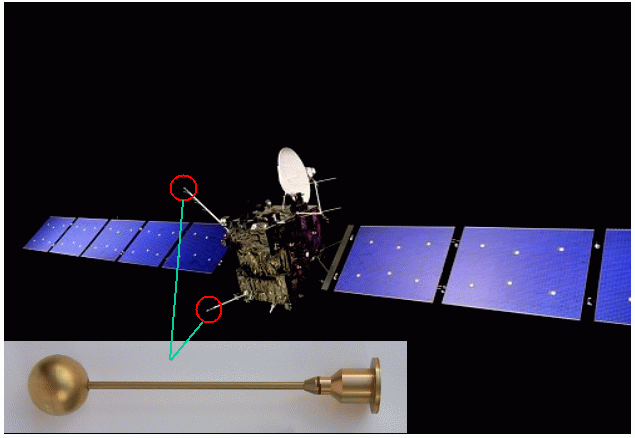
pass by these planets.The picture below shows Rosetta in space. The large bluish "wings" are the solar panels which provide electricity for all systems onboard the spacecraft. The red circles show the locations of the two sensors of our instrument, LAP. One of the two sensors is enlarged at the bottom of the picture. The sensor itself is a titanium sphere 50 mm in diameter, looking goldish because of its titanium nitride coating.
A Langmuir probe is a device to measure weak electric currents flowing between the spacecraft and the surrounding space. "Empty space" is never empty: it always contains a tenuous gas of electrically charged particles, known as a plasma. By measuring the current to the Langmuir probe while varying its potential, we can find out quantities like the density, temperature and flow speed of the plasma. As pressure is density times temperature, we measure the three fundamental properties of all weather stations: temperature, pressure and wind speed: hence we sometimes call our instrument a "space weather station".
The main target of Rosetta is a comet known as 67 P/Churyomov-Gerasimenko. Comets have always been fascinating to mankind. Nowadays, we understand that they are not only beautiful, but that they also may hold important clues to the formation of the solar system, as they are a sort of uncooked leftovers from the time when the solar system was baked into its present shape, preserved in a kind of cosmic freezer for some 4 billion years.
Science studies
There is still a long way to go to the comet, but we already have some results published:- When Rosetta flew by Mars in February 2007, we observed the bow shock forming around the planet when the solar wind flows by. The same bow shock was almost simultaneously observed also by Mars Express. The work was published by Niklas Edberg in Planetary and Space Science (2009).
- We have also published an instrument description in Space Science Reviews (2007).
- Various aspects of comets, Rosetta and LAP have been studied in a series of undergraduate projects:
- 2011: Ilona Alexandersson, Far comet ion tails
- 2010: Christian Hånberg, Parametric modelling of Rosetta spacecraft potential measurements
- 2009: Alexander Sjögren, Modelling of Rosetta Langmuir probe measurements
- 2009: Kristoffer Hultgren, Rosetta LAP operations at the target comet
- 2006: Niklas Edberg, The Rosetta Mars flyby
- 2006: Claes Weyde, Plasma parameters from the Rosetta LAP instrument
- 2005: Sofie Spjuth, Rosetta encounters with comet ion tails
- 2005: Magnus Billvik, The Rosetta Earth flybys
- 2004: Mathieu Lonjaret, Initial data from the Rosetta LAP instrument